

In the past few months, the global context has become increasingly unstable.
Geopolitical tensions, uncertainty around air travel and fluctuating demand patterns are reshaping how people plan their trips and how hotels need to react.
This is not just a theoretical scenario. It is already impacting booking behaviour, lead time and pricing dynamics across destinations.
The recent European summit in Cyprus made this even more explicit. European leaders openly discussed how to respond to ongoing instability and its ripple effects across industries, including tourism, where uncertainty is now a structural factor.
In this environment, relying on static pricing strategies or historical benchmarks is no longer enough.
When the market becomes unpredictable, pricing loses its reference points
In stable markets, pricing decisions tend to follow relatively clear patterns.
Seasonality provides guidance, pickup confirms trends and competitors move in similar directions.
Today, that reference system is breaking down.
Demand is uneven, booking windows shift suddenly and external factors, such as flight availability or geopolitical developments, can impact entire destinations overnight.
For Revenue Managers, this creates a new challenge:
how to price when the market itself is no longer predictable.
Why monitoring competitors is necessary, but not sufficient
In this context, rate shoppers have become an essential tool.
They allow hotels to monitor competitor pricing, understand positioning and react quickly to market movements. More importantly, they provide visibility not only on single competitors, but on entire destinations.
This is particularly relevant not only for Revenue Managers, but also for investors and multi-property operators, who need a broader view of how pricing evolves across markets.
However, there is a fundamental limitation.
A rate shopper shows what is happening, not why it is happening.
What recent data is telling us about market volatility
Looking at how rates have evolved across different destinations in the last 30 days, a clear pattern emerges: pricing is no longer moving in a linear or predictable way.
The following charts show the variation of median hotel rates over the last 30 days across different destinations, based on data sourced from major OTAs. This provides a consistent benchmark to understand how pricing is evolving at market level.
Paris
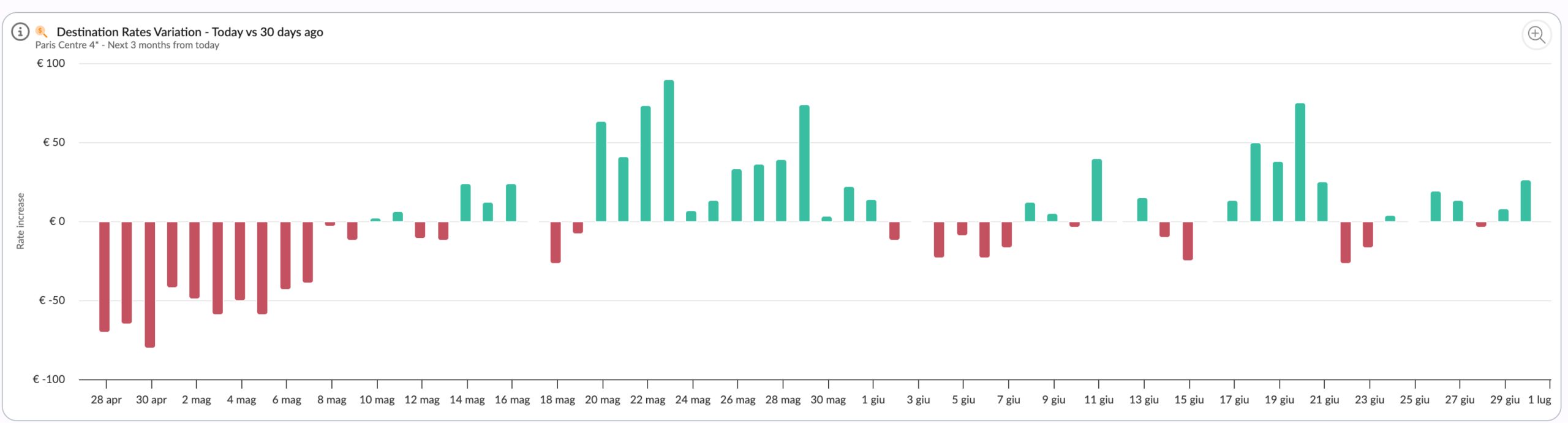
Paris shows a clear shift over the last 30 days. Early May is characterized by strong rate drops (up to €80), followed by a sharp recovery from mid-May, with significant increases before stabilizing in June.
This suggests a market reacting quickly to demand signals rather than following a steady trend.
London
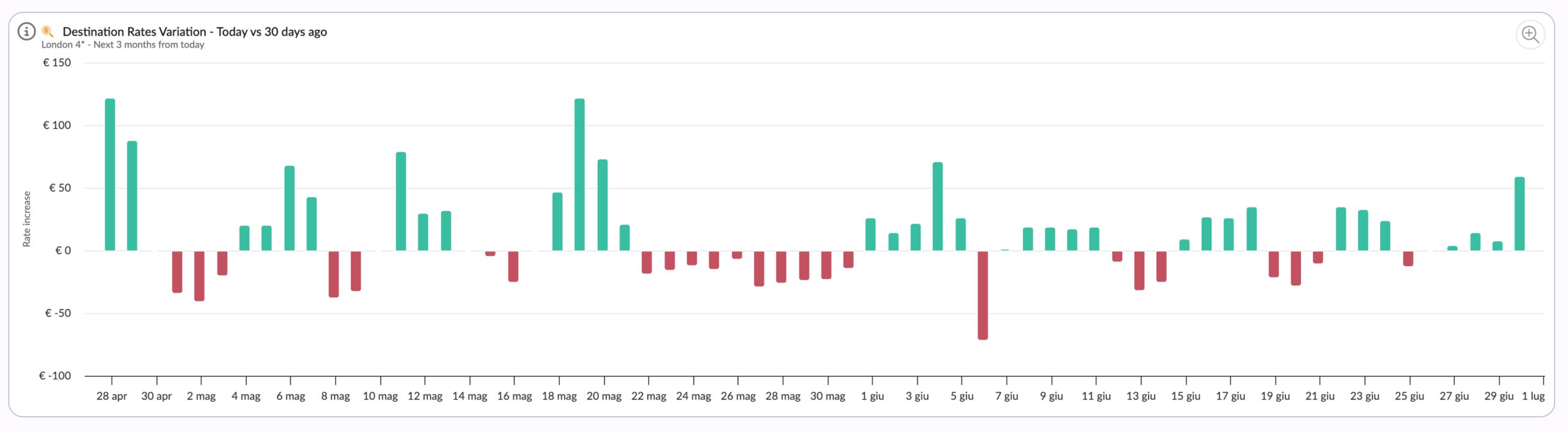
London presents a fragmented pattern, with alternating drops and spikes throughout the period. Price corrections at the beginning of May and mid-June are followed by short-lived increases.
The lack of a clear direction reflects a market struggling to stabilise, making reactive pricing particularly risky.
Istanbul
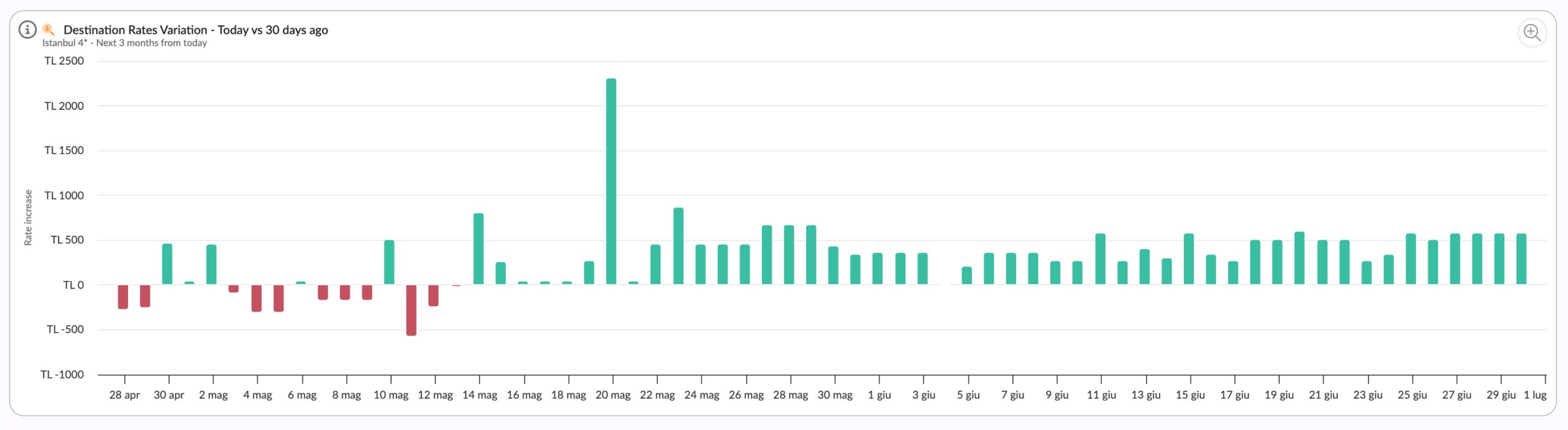
Istanbul stands out for its strong upward momentum. After a brief correction phase, rates increase significantly from mid-May, with a major spike around May 20th and continued growth into June.
This indicates strong underlying demand, combined with high volatility.
New York
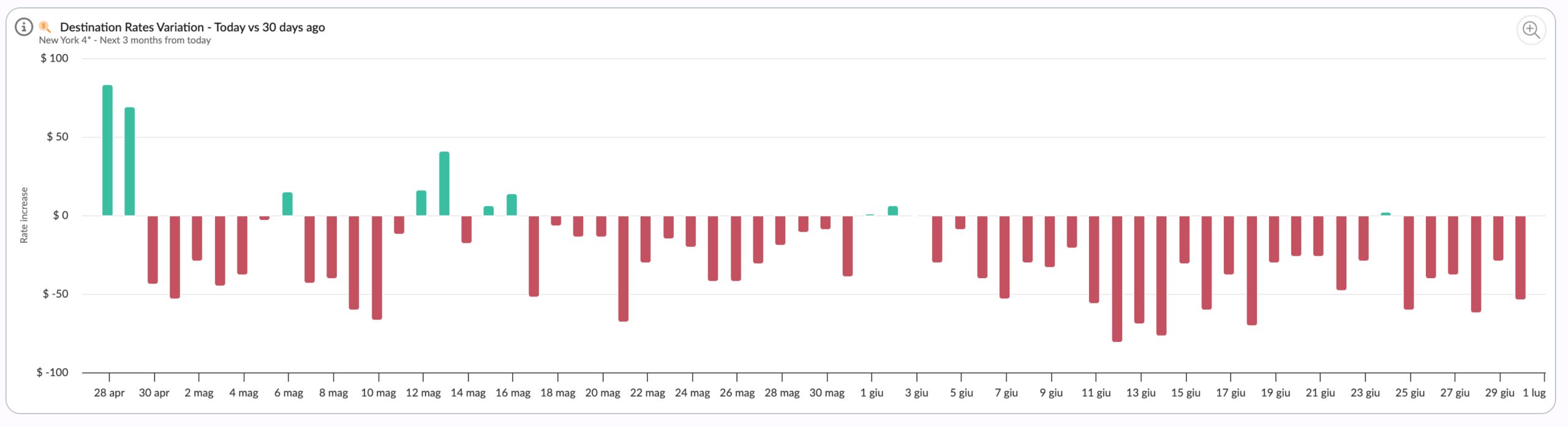
New York shows a predominantly downward trend, with frequent price reductions throughout May and June, often between -$30 and -$80.
Positive adjustments are limited, suggesting softer demand or increased competitive pressure.
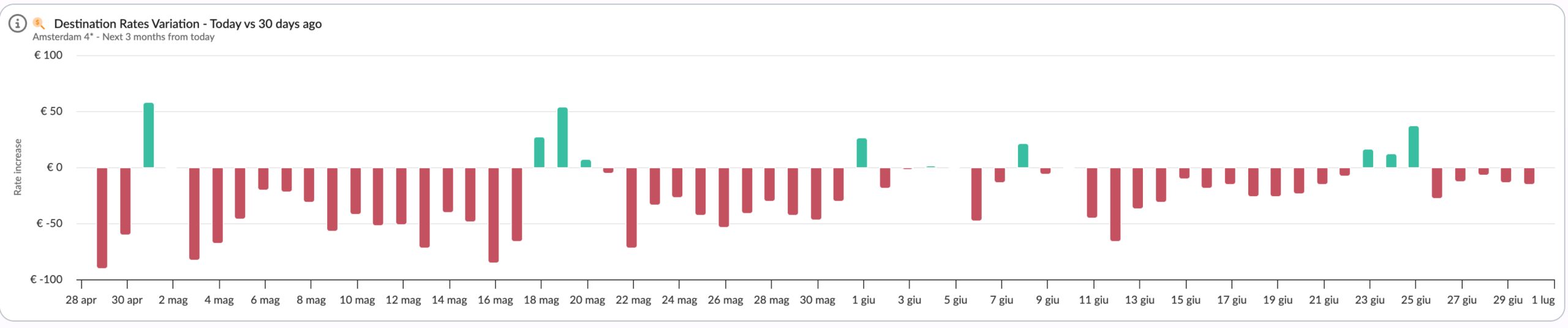
Amsterdam
Amsterdam shows a predominantly negative trend over the last 30 days, with consistent rate decreases throughout most of the period, often between -€40 and -€90. Only a few short-lived increases appear around mid-May and late June, before returning to downward
adjustments.
This pattern suggests a market under pressure, with pricing being actively corrected rather than driven by strong demand signals.
From price observation to market interpretation
These patterns clearly show that pricing is no longer moving in a uniform way across destinations.
Without context, a Revenue Manager might interpret a price drop as a signal to follow, or an increase as an opportunity to align. But these movements may be driven by completely different factors: demand shifts, flight availability, market mix changes or short-term events.
This is where demand data becomes critical.
Why pricing decisions need demand context
Understanding how many users are searching for a destination, how demand evolves day by day and which markets are driving interest provides the missing layer behind rate movements.
A competitor lowering prices might suggest weakness, but if demand is actually growing, reacting with a discount would be a mistake.
Similarly, stable or increasing rates in a context of declining demand may signal an upcoming correction.
Demand data does not replace rate shopping.
It gives it meaning.

Rate Shopper in a broader strategy
Within a modern revenue strategy, Rate Shopper should not be used as a tool for imitation, but for interpretation.
Its real value lies in combining:
• competitor pricing visibility
• destination-level insights
• real demand signals
Only in this way can pricing decisions move from reactive to strategic.
Conclusion: pricing today requires a wider lens
In a context shaped by geopolitical uncertainty and unstable travel patterns, pricing can no longer rely on a single source of information.
The ability to monitor competitors is essential.
But the real advantage comes from understanding what is driving the market behind those prices.
Because today, the key question is not just “What are others doing?” but “What is really happening in the market?”.